




Navigating senior housing options can feel daunting. This guide simplifies the process by exploring different living arrangements—from independent communities to budget-friendly apartments—to help you or your loved ones find the ideal home that balances comfort, care, and affordability for this important life transition.

55 Over Senior Housing
When I first started looking into 55+ communities for my parents, I thought they were basically just “fancier nursing homes.” Boy, was I wrong. It's more about choosing a lifestyle built around convenience and people in the same stage of life. Take my aunt in Florida—she moved into a 55+ community near Orlando last year, and her social calendar is busier than mine. She’s constantly playing pickleball, taking art classes at the clubhouse, or going on group trips organized by the community.
According to the National Investment Center for Seniors Housing & Care (NIC) 2025 report, residents in large-scale planned communities like hers participate in an average of 15+ organized social activities per month. It's less about “retiring” and more about starting a new, active chapter. But that lifestyle comes at a cost: beyond the home price or rent, monthly community fees can run several hundred to over a thousand dollars for maintaining all those pools, golf courses, and activity centers.
Real-life Example: The Villages in Florida is often cited in media as the poster child for large-scale 55+ living. Its resident-led clubs, recreational density, and social ecosystem are frequently analyzed in NIC’s 2025 sector reports as a benchmark for successful lifestyle-oriented communities.
Find Senior Independent Living
My neighbor, Bob, sold his house last year and moved into an independent living community on the outskirts of our city. As he put it, “I was done with shoveling snow and mowing lawns. I just wanted to be a ‘carefree tenant’ in my own life now.” His place feels like a cross between a college dorm and a nice hotel—there’s a dining hall, a gym, and a weekly shuttle to the grocery store and movies. His favorite part? Not having to call around for repairs anymore. One call to the front desk handles everything. But Bob warned me: don’t just trust the glossy brochures.
You have to ask exactly what’s included in the monthly fee and what costs extra. For example, his plan includes two meals a day, but if he wants steak every night, that’s an add-on. A 2025 AARP survey found that 78% of people considering independent living ranked “clear and predictable fee structures” as more important than “luxury amenities” when choosing a community.
Real-life Example: Large providers like Brookdale Senior Living operate independent living communities nationwide. Their service packages and pricing models are often used in AARP’s consumer guides as typical examples for comparison.
Single Family Homes for Seniors
A coworker of mine bought a home for her parents in a 55+ single-family community in Scottsdale, Arizona. Her mom told me, “I couldn’t give up having my own garden, but the stairs in our old house were killing my knees.” All the homes in their community are single-story, with zero-step entries and spacious bathrooms. The big draw is that while they own the home, the homeowners’ association (HOA) takes care of all exterior maintenance—landscaping, roof repairs, you name it.
A 2025 survey by the National Association of Home Builders (NAHB) found that in these types of homes, “freedom from exterior maintenance” and “accessible single-story design” were the top two satisfiers, each scoring over 95% approval from residents. My coworker did mention, though, that HOA fees creep up almost every year, and there are strict rules about everything from exterior paint colors to how long guests can stay.
Real-life Example: Master-planned communities like Sun City Grand in Scottsdale, AZ are classic examples. Their design standards, HOA structure, and resident demographics are key data points in NAHB’s 2025 research on the 55+ housing market.
Affordable 55+ Senior Apartments
Let me be honest—finding truly “affordable” options feels like searching for a needle in a haystack. It takes serious patience and luck. A friend’s mother in Cleveland, living mostly on a Social Security check of under $1,500 a month, waited three years on a waitlist for a local “Senior Housing Support” program before getting a one-bedroom apartment. Her rent is calculated at 30% of her income, about $450 a month. The building has an elevator, a community room, and a weekly wellness check by a nurse.
The National Low Income Housing Coalition (NLIHC) 2025 report highlights the brutal reality: in most major U.S. metro areas, there are only 37 or fewer affordable rental units available for every 100 extremely low-income senior renters. This isn’t just shopping; it’s a test of endurance with lots of paperwork.
Real-life Example: Subsidized senior apartments operated by local housing authorities (like the Chicago Housing Authority) or non-profits (like Mercy Housing) exist in most cities. Their multi-year waitlists and income-based rent structures are central to the data in NLIHC’s annual “The Gap” report.
Senior Residences
When I started looking for options for my aunt who needed more daily help, I got totally confused by terms like “assisted living” and “CCRCs” (Continuing Care Retirement Communities). Touring a CCRC in Pennsylvania finally cleared it up. Think of it like a “lifetime campus.” I met a retired professor and his wife who paid a sizable entrance fee over a decade ago for a cottage. Now that he needs daily medication management, he moved into the on-site assisted living building, while his wife still lives in their original home. She visits him every day. It offers incredible peace of mind for the future.
However, Genworth’s 2025 Cost of Care Survey shows the median entrance fee for a CCRC is now over $300,000, on top of monthly fees that can run several thousand dollars. It’s a major financial commitment, and the contracts are notoriously complex—getting a lawyer and financial advisor to review them is non-negotiable.
Real-life Example: Well-established CCRCs like Foxdale Village in Pennsylvania (a Quaker-affiliated community) are often studied as models. Their continuum-of-care structure, contract types, and resident transition patterns are referenced in industry analyses by groups like ProMatura and in consumer guides to long-term planning.
Summary of Senior Rental Rates
In the U.S., senior housing rental prices vary by city. In large cities like New York and San Francisco, expect to pay $2,000 to $4,000 monthly. Smaller cities usually have rents ranging from $1,000 to $2,000.
 If you're price-sensitive, here are some prices that will shock you, however, since it's not in a popular area, the environment may not be as developed and glamorous as in big cities like New York, but it still has its own natural scenery, here’s a table with U.S. locations where housing or tiny-home lots can fall in the $100–$300/month range.
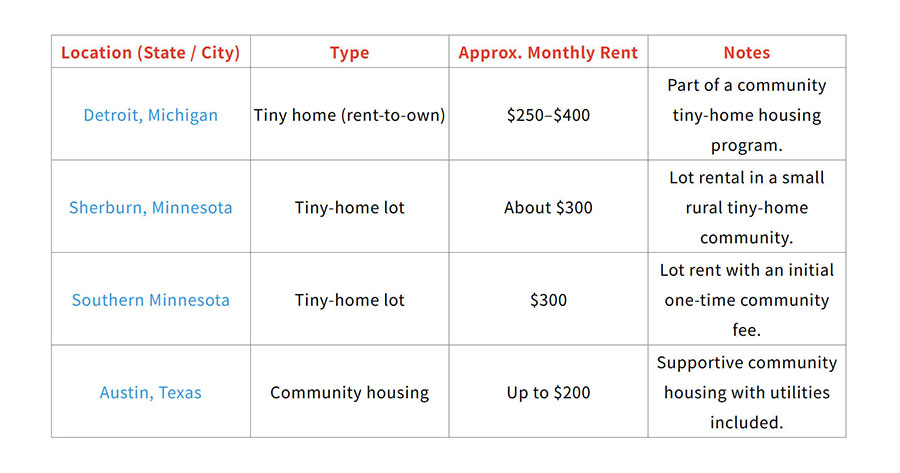
These ranges reflect conditions as of October 2025 and may vary based on local market factors.
Q&A
Q: What should I consider when choosing a senior housing option?
A: Consider factors such as location, level of care needed, cost, available amenities, and the community atmosphere. Visiting multiple options and speaking with current residents can help you make an informed decision.
Q: How can I find affordable senior housing?
A: Look for public sector-subsidized programs, non-profit organizations, and communities offering below-market rates. Contact local senior centers and housing authorities for recommendations and resources.
Q: What are the benefits of senior independent living communities?
A: These communities offer a maintenance-free lifestyle with amenities like fitness centers, dining options, and social activities. They promote an active and engaging lifestyle while providing a sense of community.
Q: Are single-family homes a good option for seniors?
A: Yes, for those who value privacy and space. These homes often come with senior-friendly features and can be part of age-restricted communities that offer additional services and social activities.
Navigating senior housing options can be complex, but by understanding the various choices available, you can find the ideal living situation that meets your needs and enhances your quality of life.
Data and Expert Sources
1. National Investment Center for Seniors Housing & Care (NIC)
Provides data on social activity participation in 55+ communities, housing trends, and case studies of large-scale senior living communities.
2. AARP (American Association of Retired Persons)
Publishes survey reports on fee structures for independent living communities, resident preferences, and consumer guides.
3. National Low Income Housing Coalition (NLIHC)
Publishes the annual The Gap report, focusing on the supply, demand, and affordability of rental housing for low-income seniors.
4. Genworth Financial
Publishes the annual Cost of Care Survey, covering entrance fees, monthly costs for CCRCs, and other long-term care expenses.
5. National Association of Home Builders (NAHB)
Conducts research and publishes annual reports on design preferences, resident satisfaction, and HOA structures in 55+ single-family home communities.
Disclaimer:
The prices mentioned in this article are approximate and can vary based on location, time of year, market conditions, and individual landlords. All figures and tables are for reference only and should not be taken as exact or guaranteed rates.